
Human rights
Freedom from slavery is a fundamental human right. Australia has signed several key international human rights treaties reiterating its commitment to fight modern slavery (see key international instruments in Appendix A).
The international community, including Australia, has committed to end modern slavery by 2030 under Target 8.7 of the ILO’s Sustainable Development Goals. To achieve this target, all sectors play a role in the process (Section 2).
In addition to international legal commitments enshrined in Australian domestic law, there are several authoritative global normative frameworks and standards that contribute to the promotion of human rights in Australia. These include, but are not limited to:
- ILO recommendations and technical guidelines
- UN Guiding Principles on Business and Human Rights (UNGPs)
- Organisation for Economic Co-operation and Development (OECD) Guidelines for Multinational Enterprises on Responsible Business Conduct.
These normative frameworks and standards, while not binding under international law, are based on human rights standards enshrined in other legally binding international instruments. They provide practical support to assist States in their duty to protect against human rights abuses within their territories, and give advice/training to individuals and organisations to recognise their responsibilities around respecting human rights, avoiding infringing on the human rights of others and taking practicable steps to address any impacts to human rights.
These normative frameworks and standards guide and support the development of Australia’s response to modern slavery, and outline how all individuals and organisations, regardless of their sector, should work to prevent and address modern slavery.
The Guidelines are non-binding and voluntary principles, and do not seek to impose additional obligations beyond applicable international and/or domestic law and policies.
A human rights-based approach
A human rights-based approach is a conceptual framework based on international human rights standards. It seeks to analyse barriers to achieving human rights, and to design effective and practical policies, practices and guiding principles that can be followed by all stakeholders. The Australian Human Rights Commission notes that the way in which a human rights-based approach is implemented will depend on the type and operations of a particular organisation. However, it notes 5 key principles when implementing this approach:
- Participation
- Accountability
- Non-discrimination and equality
- Empowerment
- Legality

The Australian Human Rights Commission has more information on human rights-based approaches and the five ‘PANEL’ principles on their website.

What is a normative framework?
A normative framework is a set of societal rules and values that guide behaviours and interactions within a community or organisation (International Encyclopedia of the Social & Behavioural Sciences).
A human rights-based approach supports:
- empowering people who have experienced modern slavery to know their rights and feel supported to claim these rights for themselves
- a non-discriminatory approach that ensures people who are most vulnerable to serious exploitation are able to access support
- accountability of individuals and organisations who are responsible for either respecting, protecting, or fulfilling human rights
- provision of practical guidance, policies and processes for individuals and organisations which focus on instilling human rights, respect and dignity.
You can find out more about human rights-based approaches on the Australian Human Rights Commission website.
"A human rights-based approach encourages us to look beyond the mechanics of service delivery and instead make people our central focus. It ensures that dignity, respect and empowerment are central to our interventions. This approach not only supports and empowers individuals who have experienced modern slavery, but helps address root causes rather than merely addressing symptoms."
– Lorraine Finlay, Australian Human Rights Commissioner
Roles and expectations
Each sector working on modern slavery issues has different roles, expectations and/or obligations to promote human rights. As an example, the UNGPs contain 3 non-binding pillars (see Figure 4). Learn more in the United Nations Guiding Principles on Business and Human Rights.
Non-binding pillar 1: State Duty to Protect
- States have an existing obligation under international law to respect, protect and fulfil the human rights and fundamental freedoms of all within their territory.
- Giving effect to this obligation may include, but is not limited to:
- taking steps to prevent, protect and prosecute through effective policies and legislation
- setting out expectations for businesses and NGOs to respect human rights throughout their work and operations
- enforcing laws and policies that include requirements for businesses and NGOs to respect human rights, and ensuring they enable, not constrain these organisations from respecting human rights
- providing guidance on how to respect human rights and encouraging organisations to address their human rights impacts.
Non-binding pillar 2: Corporate Responsibility to Respect
- Businesses and other non-government entities, as specialised groups performing specific functions, should comply with all applicable laws and respect human rights.
- This includes, but is not limited to:
- understanding international human rights, at a minimum those expressed in the International Bill of Rights and the principles set out in the ILO’s Fundamental Principles and Rights at Work
- avoiding adverse human rights impacts and addressing these impacts when they occur
- implementing policies and processes to meet their responsibility to respect human rights
- carrying out human rights due diligence (Principles 17–21), which includes assessing actual and potential human rights impacts and acting on the key findings.
Non-binding pillar 3: Access to Remedy
- As a key component of their duty to protect against business-related human rights abuse, States must take appropriate steps to ensure that those impacted by such abuses in their territory have access to effective remedy.
- This includes, but is not limited to, taking appropriate steps to ensure State-based judicial and non-judicial mechanisms are able to address human rights abuses and do not prevent people with lived experience from presenting their cases.
- Businesses and other relevant enterprises should provide and participate in effective mechanisms to address grievances from individuals adversely impacted by their operations (refer to grievance mechanisms and remediation).
Trauma-informed practice
The Blue Knot Foundation has developed a series of fact sheets to support people to understand the different categories of trauma.
Modern slavery denies people the fundamental freedoms that every person should be able to access. This process of removing agency, trust and dignity can have a lasting impact on a person’s life.
Trauma is a complex physical, emotional and psychological response to an event or series of events, such as those that occur during experiences of modern slavery. Visit Blue Knot Foundation's What is Complex Trauma fact sheet and SAMHSA's Concept of Trauma and Guidance for a Trauma-Informed Approach to learn more.
Trauma may impact individuals in diverse and profound ways. While it is not possible to provide an exhaustive list of the many ways in which trauma can affect a person’s life, this can include immediate and long‑lasting impacts on their physical, mental, emotional, social and spiritual wellbeing.
Each person’s recovery journey is deeply personal and unique, and can take time. Access to holistic support, particularly trauma-focused mental health care, is crucial to healing from trauma.
Trauma can impact interactions with and outcomes for people who have experienced modern slavery, and the organisations and individuals they engage with. People who have experienced modern slavery, and those engaging with them, may fear that engagement will trigger or exacerbate trauma.
An understanding of trauma and strategies that effectively address it are beneficial for all involved.
Trauma-informed practice involves integrating an understanding of trauma, its varied impacts on people and pathways to recovery into our work. This approach helps us to acknowledge, normalise and navigate the effects of trauma.
"On the importance of minimising harm – ‘If we are coming to the system for help, survivors may start to perceive the system as co-perpetrators because they are harmed in the process of trying to get help'."
– Member of the Survivor Advisory Council
Critical objectives of trauma-informed practice include:
- Minimising harm: avoiding actions that can cause further harm and re-traumatisation.
- Prioritising safety: prioritising physical, psychological and emotional safety.
- Supporting healing: supporting healing and recovery.
- Empowering autonomy: supporting agency and autonomy.
- Recognising strengths: recognising strengths and resilience in managing trauma responses.
On safety
The Modern Slavery Lived Experience Engagement and Empowerment guidance document provides in-depth information on safe and trauma-informed engagement, including key considerations when planning engagement with people with lived experience.
Additionally, organisations need to be mindful of their obligations under the Work Health and Safety Act 2011 (Cth), which extends to both employees and third parties.
Minimising risk and managing duty of care
Minimising risks when working with people who have experienced modern slavery and managing a duty of care to minimise harm and avoid re-traumatisation can be tenuous, and managing this tension while respecting a person’s autonomy and agency can be challenging. Inherent to a person’s autonomy is the need to assess and manage risks from their perspective, incorporating their understanding of outcomes. The aim of all engagements should be to fulfil the duty of care by helping the person to be informed of and evaluate risks, and by building their skills and resilience to respond to and make decisions. A person may feel the need to take risks as part of their healing and growth journey. Often, individuals and organisations may themselves take on the burden of outcomes for people who have experienced modern slavery. This is one of the contributors to burnout and vicarious trauma. Strategies on how to minimise harm and re-traumatisation should be developed before engagements begin (refer to trauma-informed approaches and cooperation and professional conduct).
Experiences of modern slavery often involve prolonged and repeated exposure to circumstances that can result in what is known as ‘complex trauma’. The impacts of complex trauma can be pervasive, for example, affecting a person’s ability to regulate emotions, form and maintain relationships, and have a positive self-concept. Trauma-informed practice can help facilitate safe, trusting and empowering engagement between organisations, individuals and those who have experienced modern slavery. This is crucial to supporting healing from the interpersonal trauma of modern slavery.
Additionally, those working with people who have experienced modern slavery can develop vicarious trauma either through exposure to disclosures of traumatic experiences, or their own personal history of trauma. Adopting trauma-informed practice is integral to protecting everyone’s wellbeing.
Figure 5 summarises 6 key principles to help implement trauma-informed practice. These principles should be considered holistically, with the understanding that each principle may be interpreted and applied differently depending on the context. For more information, visit Survivor Connections' Trauma Informed Approach page.
Figure 5: Key Principles of trauma-informed practice
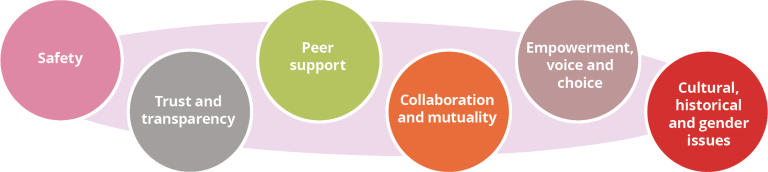
Figure 5 is a diagram of 6 coloured circles in a row indicating the 6 key principles of trauma-informed practice.
The first circle reads: ‘Safety’. The second circle reads: ‘Trust and transparency’. The third circle reads: ‘Peer Support’. The fourth circle reads: ‘Collaboration and mutuality’. The fifth circle reads: ‘Empowerment, voice and choice’. The final circle reads: ‘Cultural, historical and gender issues’.
Trauma-informed Principles: what do they mean
Safety
Create an environment where people who have experienced modern slavery feel physically, emotionally and psychologically safe, secure and ready to engage. Safety is different for each person. It is important to ask what safety means to individuals.
Collaboration and mutuality
Build relationships based on mutual respect and an awareness of power imbalances. This principle promotes collaboration and partnership, recognising that everyone has a role to play in a trauma-informed approach.
Trust and transparency
Building trust requires transparency in both actions and decisions. Open, honest, clear and consistent communication is essential for building trust. This includes being clear about what people can expect from engaging and consistently following through on outlined commitments.
Empowerment, voice and choice
Emphasise strengths and resilience, and recognise and respect the individual’s right to choose and control their own voice, story and decisions. This includes validating lived experiences and fostering an environment where people can thrive and succeed.
Peer support
Peer support is crucial for collaborating with those who have experienced modern slavery. Navigating complex systems alongside others who have shared similar experiences is an important part of the recovery and healing process.
Cultural, historical and gender issues
Understand and address the cultural, historical, gender and sexuality contexts of others’ experiences, and recognise that these contexts create different service needs.
"Without education about trauma and mental health support, a trauma survivor can feel like they are in a nightmare, trying to run from darkness to light, but never getting there. Helping survivors understand why the trauma causes the mental and physical impacts they are experiencing, and the recovery process, can be the key to unlocking hope for the future."
– Roxan Fabiano, Executive Officer, HerSpace.
"People with lived experience of modern slavery or forced marriage have experienced severe trauma and it is very prevalent amongst them. It can have significant negative impacts in all aspects of their lives, including physical, social and mental health.
A trauma-informed approach allows people to acknowledge, validate and recognise the signs and symptoms of trauma which can then assist in providing a safe, supportive environment for the recovery and needs of the victim survivors. This approach is a non-judgemental approach and avoids the re-traumatising of the victim survivors or triggering events and the individual is also able to build trust and rapport, and the workers are also able to provide tailored support which will be more effective and achieve a long-term support."
– Helena, survivor of forced marriage, Research Assistant for My Blue Sky and Director of Boland Parwaz PTY LTD
Communication matters
It is important that individuals and organisations build trust and rapport with those they engage so that support can be provided to them in the ways they need. Core to building rapport is being mindful of the language used and its delivery.
The words we choose reflect our attitudes. To be trauma-informed, our language should be:
- adaptable to specific circumstances and contexts
- affirming and encouraging of resilience and strengths
- clear and understandable
- consistent with our tone of voice and body language
- demonstrating belief
- expressing choices and options respectfully
- free from negative labels
- free of jargon, confusing data and speculative comments
- mirroring the language and phrases used by the person we are communicating with
- non-judgemental
- normalising and validating of thoughts, feelings and responses
- reflecting back what you have heard to demonstrate understanding
- truthful
- open-ended rather than closed-ended questions (where possible).
Language has the ability to have both tangible and intangible impacts. It can influence a person’s psychological wellbeing and healing process, as well as shape their journey, including how they might access support and remediation. It is important that individuals and organisations embed language in their vocabulary that centres a person’s human right to be free from exploitation (see Table 3).

For example, if a person who has experienced modern slavery was to self-identify as someone experiencing serious exploitation to an organisation or law enforcement, it is important that the language used in identification processes is open and flexible enough to appropriately consider all possible presentations of modern slavery. This approach could prevent misclassifications and ensure that people who have experienced modern slavery are able to access the relevant supports available.
Messaging guide, developed by the Modern Slavery and Human Rights Policy and Evidence Centre, is useful in assisting all individuals and organisations to frame modern slavery and increase public understanding in a way that is evidence-based and informed by lived experience expertise.
Trauma-informed principles of language |
|
Avoid |
Consider |
| Doing for people | Doing with people |
| Symptoms, pathologies and maladaptive | Coping strategies |
| Service /practitioner as expert | Person as expert on own life |
| Treatment and cure | Healing and recovery |
Trauma-informed language to use when working with a client |
|
Avoid saying… |
Consider saying… |
|
‘What’s wrong with you?’ ‘You need to tell us what happened for us to help you.’ |
‘I can see that something is troubling you, are you feeling okay?’ ‘Is something worrying you?’ ‘You don’t need to talk about anything that makes you feel uncomfortable. If there is anything you feel would be helpful for you to share, I am here to listen whenever you are ready.’ |
|
‘It’s over, you don’t need to feel that way anymore.’ ‘You are safe now; you no longer need to feel afraid.’ ‘That’s so terrible, I can’t believe that happened.’ ‘You shouldn’t be blaming yourself.’ ‘Can you tell me the details of what happened in order?’ |
‘It’s normal for you to feel this way after what you’ve been through.’ ‘It can take time for you to feel safe again. I’m here when you are ready to talk about what you feel may help you to feel safe.’ ‘Thank you for sharing with me. I really value your trust. I’m very sorry that happened to you.’ ‘It’s normal for people to feel the way that you’re feeling. What happened to you wasn’t your fault.’ |
| Noncompliant/disengaged |
‘It’s normal for trauma to affect our memories of what happened. Feel free to share whatever comes to mind, and at your own pace. It’s ok if you don’t remember anything.’ ‘I can understand you have experienced a lot recently. Is there anything I can do to help you?’ ‘What are your biggest concerns at the moment?’ ‘If there are ways that I can help make you feel safer in Australia / your home, can you please let me know? I can try to help you put some things in place to make you feel safer.’ ‘What makes you feel safer and how can we better support you?’ ‘Only you know what is best for you. It’s ok if you feel now is not the right time for you to engage. We are here for you whenever you feel ready.’ |
| ‘These are the service options.’ ‘This is what you need to do.’ |
‘How can we make it work for you?’ ‘There are some different options available to you, what would work best for you?’ |
| ‘You should talk to someone/report to the AFP.’ |
‘Thank you for telling me about your experiences. There are some people who may be able to provide you with information and support, would you like their information?’ ‘What you have described sounds very serious. Have you considered telling the police in Australia about it?’ |
Modes of communication
The mode of communication that an individual or organisation chooses when engaging with a person who has experienced modern slavery is important to ensure that they feel safe, comfortable and ready to engage. Some modes of communication may be identified as triggering or re-traumatising for the person who has experienced modern slavery due to the circumstances of their exploitation. For example, some people may not like phone calls, while others may not want to leave their home environment or travel on certain modes of transport.
Steps should be taken to work closely with the person to facilitate safe and effective communication.
All engagement with people who have experienced modern slavery, regardless of which sector they belong to, or what stage of the journey it takes place at, should consider the principles of a trauma-informed approach to ensure that these engagements are not only safe and ethical, but also contribute to restorative and healing efforts for people who have experienced modern slavery.
"In some cases, the way we talk to people will make the difference in how they respond. If people feel respected and appreciated, it might be easier for them to open up and share their story or ask for help. Sometimes people forget that they’re dealing with humans. They think that just because someone goes to the police and they’ve been removed from the place that they were being hurt, that would be enough. But it’s not true. We also have to be very careful with the things we say and the way we say it."
– I.V
Trauma-informed practice is a process of continuous improvement. Individuals and organisations may not always get it right when it comes to language and other processes related to taking a trauma-informed approach. Every situation is an opportunity to learn. An important tool to support this learning process is ‘reflective practice’. Reflective practice is a process of examining our experiences, thoughts, feelings and actions to understand what is helpful in assisting people who have experienced modern slavery and what is not helpful. By undertaking reflective practice, individuals can continuously learn from their conduct in interactions and engagements and be guided by and responsive to people who have experienced modern slavery. Learn more on the University of Edinburgh's Gibbs' Reflective Cycle page and Cambridge University's Getting starting with Reflect Practice page.
The resource from the Helen Bamber Foundation has been designed to enable all professionals to build mutually trusting relationships with survivors, create calm and safe spaces, and increase the confidence of both workers and people with lived experience to minimise re-traumatisation, vicarious trauma and burnout.
The Toolkit for Building Survivor-Informed Organizations, developed by the U.S. National Human Trafficking Training and Technical Assistance Centre and available on the Survivor Alliance website, aims to build the capacity of organisations to support and collaborate with people with lived experience and staff. It provides practical assessment tools to evaluate the degree to which your organisation is trauma-informed.

Advice from a person with lived experience
Encouraging reflective practice
Reflective practice is a process where individuals are encouraged to think honestly, deeply and critically about their work with people who have experienced modern slavery.
This is a way to encourage learning from mistakes in practice and incorporating lessons into policies and procedures, to allow for continuous improvement.
Reflective practice can take many different forms and will be dependent on what works best for each individual or organisation. An example of a process to follow can be seen in Figure 6.
Figure 6: Gibb’s Reflective cycle, a modification of Kolb’s experiential learning cycle
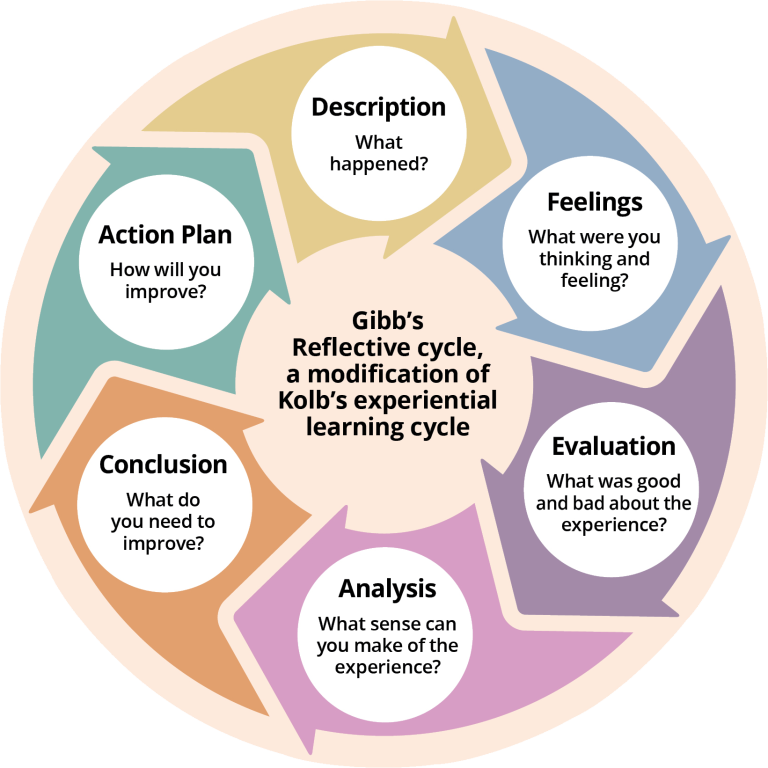
Figure 6 is a cycle diagram with 6 colourful arrow shapes pointing in a clockwise direction within a large circle. Each arrow relates to a step in the cycle.
The first arrow in the circle is titled ‘Description’ and reads: ‘What happened?’. The second arrow in the circle is titled ‘Feelings’ and reads: ‘What were you thinking and feeling?’. The third arrow in the circle is titled ‘Evaluation’ and reads: ‘What was good and bad about the experience’. The fourth arrow in the circle is titled ‘Analysis’ and reads: ‘What sense can you make of the experience’. The fifth arrow in the circle is titled ‘Conclusion’ and reads: ‘What do you need to improve?’. The sixth arrow in the circle is titled ‘Action Plan’ and reads: ‘How will you improve?’.
Implementing a trauma-informed approach is not only a key step towards respecting the human rights of a person who has experienced modern slavery but also significantly supports minimisation of harm, the risk of re-traumatisation, and the re-building of an individual’s agency and self-determination. Learn more on the Blue Knot's Stress Response and Grounding pages.
Table 4 compares trauma-informed and non-trauma-informed approaches.
Non-trauma-informed approach |
Trauma-informed approach |
| Disclose information as it occurs and only about processes that directly involve you or your organisation |
Provide clear information about the entire process of engagement and ensure that each step is well understood. Be open and transparent about processes you are unsure of and advise of steps you are taking to find more information. Be clear about what services can be provided and avoid promising or overcommitting to action if it is not able to be supported within the organisation. |
| Provide limited choices based on what you think is best. |
Provide a diverse range of eligible options and explain what they mean in practice. Individuals and organisations should also remain cognisant of common trauma impacts, which include difficulty in processing information and making decisions. Individuals and organisations should recognise this so that they do not get frustrated when someone who has experienced modern slavery cannot decide between options or commit to a path. |
| Ignore or dismiss options that a person may be ineligible for but the person thinks are relevant. | Explain in detail why a person might not be eligible for a particular option. |
|
Engage in spaces that are convenient and available for you only. Ask how the physical environment or other aspects of the engagement can be organised differently to support the person. |
Be mindful of how the space in which engagement takes place can impact upon feelings of safety and security. |
| Proceed with limited consideration of what someone might need to engage effectively. |
Consider how factors such as gender, sexuality, race, ethnicity, faith etc. might impact upon the engagement. Ask what changes could be made to ensure a person feels safe and ready to engage, such as asking if they would like to engage with someone of the same gender, cultural background, language group etc. |
Benefits of further training in trauma-informed practice
Trauma theory can assist you to identify, understand, and respond to trauma. Further training in trauma-informed practice will help you to explore trauma and acquire additional knowledge to navigate key questions, such as:
How can I recognise when a person is experiencing trauma-related impacts? Trauma screening and assessment tools can help identify whether someone is experiencing effects and symptoms related to trauma. It is important to know the different tools, their purpose, advantages and limitations, and who can appropriately administer them.
How does a person recover from trauma? Different frameworks exist for trauma recovery – there is no one-size-fits-all approach. One of the most recognised frameworks suggests establishing safety and stability, addressing traumatic memories and responses, integrating experiences, and moving forward. These are not linear stages and a flexible approach is key. People with lived experience can seek trauma-specific recovery services and programs (that involve trauma-focused therapeutic approaches and mental health specialists) to help them engage in a guided trauma-recovery process.
If I’m not a therapist, can I still help in the trauma-recovery process? Yes. In addition to following the principles of trauma-informed practice in the Guidelines, you can also engage in further training in trauma-informed practice. This training provides practical insights into trauma’s effects on the brain and stress response system, common trauma responses and indicators, the recovery process and approaches, and helpful coping strategies. It can teach people how and when to apply practical techniques that aid in trauma recovery, such as active listening, grounding techniques, mindfulness and self-regulation skills.

Useful grounding tools have been developed by Blue Knot Foundation that can support individuals and organisations that work with people who have experienced modern slavery. Also refer to the vicarious trauma section.

‘You don’t have to be a therapist to be therapeutic; there are a variety of tools and techniques that anyone can learn to help themselves or others on the trauma-recovery journey. Training in trauma-informed care can equip you with a toolbox of practical techniques to sensitively draw from in different scenarios.’
– Roxan Fabiano, Executive Officer, HerSpace

Checklist of considerations when implementing trauma-informed practice*
Do you have training and awareness-raising materials or mentoring available for staff to learn about trauma-informed approaches?
Do you have opportunities for staff to build their skills to work in a trauma-informed way?
Have you considered or do you have any tools that might support staff to implement trauma-informed principles?
Have you considered how you might implement the principles of a trauma-informed approach in your organisation?
- Are there any policies or procedures in place to support this?
What adjustments need to be made to ensure the principles are prioritised?
Have you considered how your organisational culture might be adjusted to incorporate a trauma-informed approach to better understand various behaviours?
Have you fostered an environment that would support implementation of a trauma‑informed approach?
- Are there dedicated spaces to work with trauma-impacted people?
- Are there dedicated spaces for staff if they need support?
Do you have the right people in your organisation to support implementation of a trauma-informed approach?
Do you have review or feedback mechanisms in place for continuous improvement in implementing a trauma-informed approach?
Do you have training and supports available for staff who may experience vicarious trauma?
* This is not an exhaustive list. For a full guide, please refer to the suggested resources.
The Blue Knot Foundation’s National Centre of Excellence for Complex Trauma provides information about the impacts of complex trauma, as well as a tool for people who have experienced or are supporting someone who has experienced complex trauma.
The Trauma-informed Organisational Toolkit was developed in 2023 by With You and NSW Legal Aid, with funding from the Attorney-General’s Department, to provide guidance to the legal sector on implementing trauma-informed approaches. The advice provided in this toolkit can be applied to a number of sectors, and can support individuals and organisations with recognising and responding to trauma to deliver effective services.