
Introduction
The Guidelines for NGOs: Working with trafficked people (Guidelines for NGOs) were first developed in 2008 by members of the National Roundtable, and updated in 2010 and 2015, to assist community and support groups to engage effectively and sensitively with people who may have been trafficked. This fourth edition updates the Guidelines for NGOs as an action item under the National Action Plan to Combat Modern Slavery 2020–25 (the National Action Plan). The initial edition and subsequent updates of the Guidelines for NGOs focused on the unique contribution of NGOs working with trafficked people. Since this time, the modern slavery landscape has changed significantly. Modern slavery manifestations, risks, challenges and responses are continuously evolving, with more organisations and sectors directly engaging with people who have experienced modern slavery. This fourth edition of the Guidelines broadens its target audience to support a greater diversity of stakeholders in Australia. The core purpose of the Guidelines remains unchanged: to provide practical advice and guidance to organisations working with people who have experienced, are experiencing or are at risk of modern slavery (referred to subsequently in this document as ‘people who have experienced modern slavery’). Refer to the 'Terminology' dropdown on the landing page for further details.
These Guidelines have been developed by stakeholders working in the modern slavery sector, for the sector, and articulate high-level principles and guidance for individuals and organisations across Australia. They are not intended as a binding set of rules or a singular approach to working with people who have experienced modern slavery, nor do they create additional obligations and expectations on individuals and organisations. Sectors may draw upon these Guidelines to develop their own materials, including sector-specific principles and guidance.
"The Guidelines are not just a magazine for coffee tables. Frontline staff need to have a good read of it as well and recognise the balance of power of a victim-survivor coming in to talk to the frontline, so to understand what the process might be."
– Member of the Survivor Advisory Council
Objectives
This edition of the Guidelines aims to:
- Set out good practice principles and practical guidance for working with people who have experienced modern slavery.
- Help individuals and organisations to update or develop processes relevant to their organisation, guided by best practice.
- Assist individuals and organisations to identify relevant support services and resources.
Who the Guidelines are for
The Guidelines are intended to support any individual or organisation that works with, or may need to identify, support or engage with, people who have experienced modern slavery, promoting a collaborative response. We recognise that people experiencing modern slavery face various challenges and interact with a diverse range of individuals, organisations and sectors to address their needs.
Refer to structure for more information about how the Guidelines may apply to you.
How to use the Guidelines
The Guidelines provide:
- a brief background on modern slavery and Australia’s response
- updated guidance on trauma-informed practice
- good practice values and principles to work safely and ethically with people who have experienced modern slavery and to minimise further harm during engagement
- practical guidance for all individuals and organisations.
Structure
The structure of the Guidelines is flexible to enable individuals and organisations to find information most relevant to them.
Sections 1, 2, 3, 4.1 and 5 provide information about modern slavery, partnership and collaboration, and trauma-informed approaches. They may apply to all stakeholders reading these Guidelines.
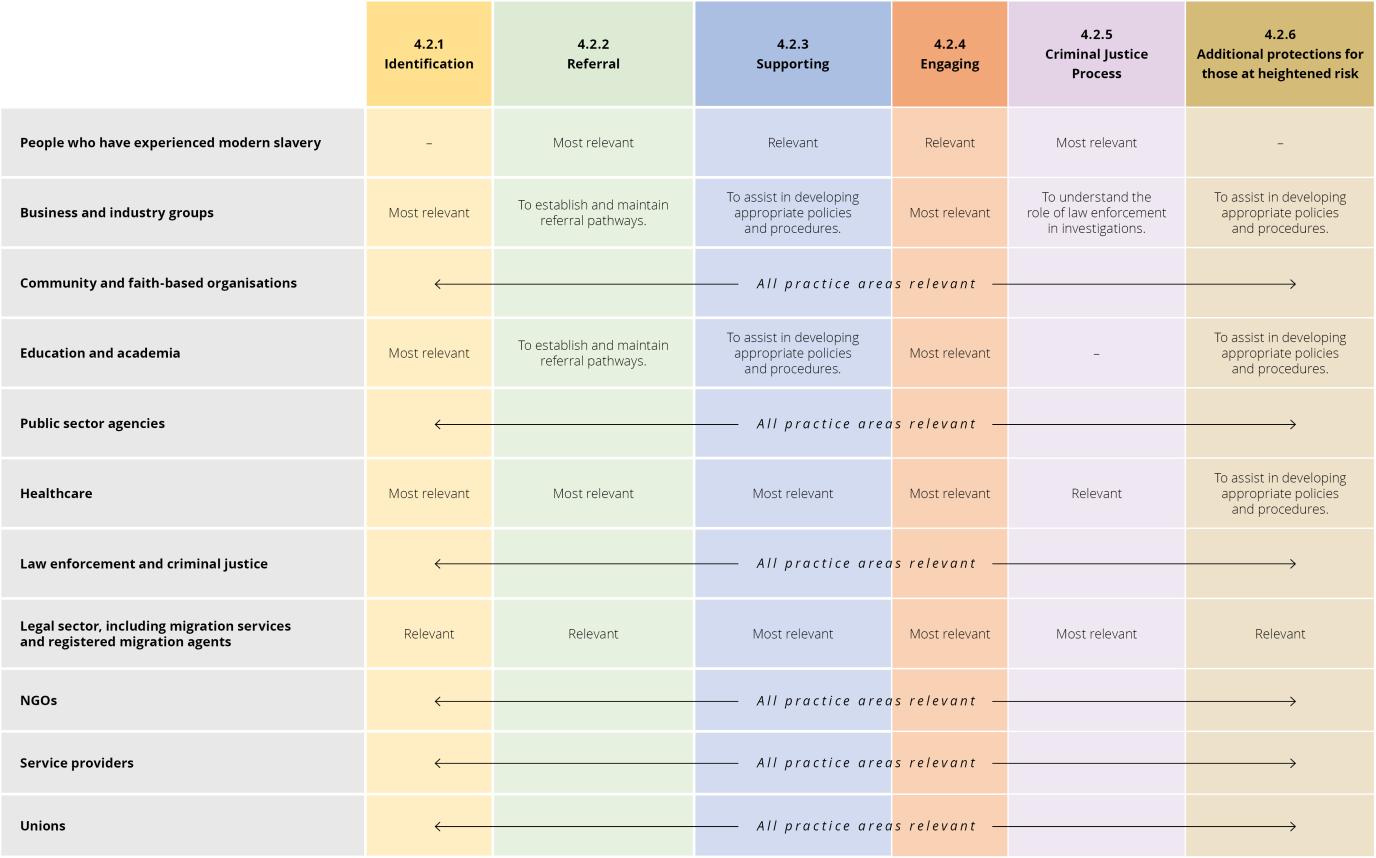
Section 4.2 has been broken down into 6 Practice Areas and provides guidance on how to work with people who have experienced modern slavery at different stages of a person’s journey. Some Practice Areas may be more relevant to certain stakeholders than others. Refer to the mapping stakeholders to relevant Practice Area for more information about how Section 4.2 may apply to you.
The Guidelines include practical tips, checklists and resources for working with people who have experienced modern slavery. The key is designed to assist with navigating information most relevant to you:

Helpful tips, reminders & facts

Examples & case studies

Checklists

Resources

Actions

Reflections from people who have experienced modern slavery (for the Guidelines)

Reflections from practitioners in the anti-slavery sector (for the Guidelines)
Further resources can be found on the additional and useful resources page.
Importance of centering people who have experienced modern slavery
According to the Global Fund to End Modern Slavery, 'meaningful engagement' refers to the inclusion of a diverse range of people who have been impacted by modern slavery throughout the development, implementation and evaluation of materials and strategies. People who have experienced modern slavery are experts of their own experience and can offer invaluable insights on how modern slavery can manifest in Australia and the potential effectiveness of certain policies and programs. Find out more in Anti-Slavery Australia's Beyond Storytelling: Towards Survivor-informed responses to Modern Slavery report.
"After all I went through, having the opportunity to share my experiences makes me feel empowered. I also feel that I have the responsibility of sharing in order to prevent others from going through the same situation or to make them feel that they’re not alone."
– I.V
Values that shape engagement
The Guidelines are underpinned by the following values around engaging and working with people who have experienced modern slavery.
These values have been developed by the Working Group using international and domestic good practices and standards, and are informed by consultations with the modern slavery sector, including those with lived experience.
Respect and dignity
What this value means
- All people have the right to have their dignity honoured and their entire being respected, regardless of their experiences or background.
Value in practice
- Recognising the inherent worth of all individuals.
- Using respectful means of communication.
- Creating spaces that are safe and respectful, and conducive to healing and restoration.
Lived experience-centred and inclusive
What this value means
- People who have experienced modern slavery should be afforded self-determination and autonomy in decision-making and be invited to, included in, participate in and be central to processes, decisions and engagements concerning their own journey.
Value in practice
- Supporting individuals in defining their goals and healing outcomes.
- Acknowledging the unique skills, contributions and knowledge of people who have experienced modern slavery.
- Ensuring accessibility to facilitate effective contributions and collaboration, and adapting practices to meet the needs of diverse individuals.
- Awareness of potential harm, trauma and discrimination that may arise as a result of engagements, misconceptions and biases around modern slavery.
Equity and equality
What this value means
- All human beings have the same intrinsic value and deserve access to the same fundamental human rights, opportunities and respect (equality).
- Recognising that each individual is different and pathways may need to be adapted to achieve equal outcomes (equity).
Value in practice
- Equal access to comprehensive and tailored support that addresses specific needs.
- Inputs and contributions should be equally valued.
Agency
What this value means
- Supporting the empowerment of people to take action and choose their own pathway, recognising that each person is the expert in their own lives.
Value in practice
- People who have experienced modern slavery should feel empowered by the support they receive to make informed decisions about their future and retain their agency and autonomy.
Strengths-based
What this value means
- Focusing on a person’s strengths and resources is more empowering than concentrating on what they lack or the challenges they face.
- All people who have experienced modern slavery should feel that their strengths, capabilities and goals are valued.
Value in practice
- Identifying and leveraging the strengths, skills and resources of individuals, their families and communities.
- Using language that is encouraging, collaborative and respectful.
- Working to understand the broader drivers, structural barriers and risks that different people may face (for example, responses to race, class and gender) and how these impact experiences of modern slavery.
- A strengths-based approach should be used in close collaboration with the other values for engagement.
Trauma-informed
What this value means
- Recognising and responding to the profound impact of trauma on individuals who have experienced modern slavery, as well as on others affected by trauma.
Value in practice
- Recognising the complex and diverse responses to trauma.
- Engaging in a holistic manner that supports empowerment and healing, while minimising harms, re-traumatisation and vicarious trauma.
- Training staff on trauma-informed responses.
Culturally safe and responsive, and gender and sexuality-sensitive
What this value means
- The right to support and engagement that is safe, sensitive and specific to their culture, race, faith, gender and sexual orientation.
Value in practice
- Creating welcoming and responsive spaces.
- Respecting diversity and actively promoting learning, understanding and responding to a wide range of experiences.
- Avoiding stereotyping and bias, and actively working to unlearn them.
- Being careful of tokenism, condescension or paternalism.
- Being aware of how organisations represent their own staff members who may be gender, sexuality, culturally and/or linguistically diverse.
Transparency and informed consent
What this value means
- The right to understand and be at the centre of decision-making processes related to one’s own experiences.
- Informed consent is essential for any individual or organisation working with people who have experienced modern slavery.
Value in practice
- Engaging in open and honest dialogue about all processes and decisions.
- Being transparent about the services and assistance that organisations can provide.
- Avoiding promises that cannot be fulfilled and clearly explaining any risks associated with particular actions and how the person’s information or expertise will be used.
- Providing opportunities to revise input, amend statements or accounts, and withdraw from involvement.
Confidentiality and privacy
What this value means
- It is essential to respect the privacy and confidentiality of people who have experienced modern slavery to protect their safety and dignity.
Value in practice
- Never sharing information with others without the person’s fully informed consent, except in cases of: immediate danger, limited decision-making capability, or where mandatory reporting or specific legislative requirements apply.
Collegiality and partnership
What this value means
- Our collective response to modern slavery is strengthened through partnerships and practical collaboration across sectors that provide support.
Value in practice
- Treating everyone with respect and dignity, including colleagues working in the anti-slavery sector.
- The values above should be considered in all engagements with colleagues and other professionals/practitioners.
"First of all, we all deserve respect. We all experience life in different ways and circumstances. Secondly, not everyone needs the same attention in the same amount. Plus, the fact that we all come from different backgrounds and beliefs. Finally, this process must be clear all the way for the victims, but also confidential."
– I.V
The Modern Slavery Lived Experience Engagement and Empowerment: Values, principles and practical guidance to support trauma-informed engagement and empowerment in Australia (Modern Slavery Lived Experience Engagement and Empowerment guidance document), developed by the Attorney-General’s Department (2024), includes a number of useful case studies and checklists on implementing some of these values when working with people who have experienced modern slavery. This document has been referred to throughout the Guidelines, especially in Practice Area 4: Engaging with a person who has experienced modern slavery.
Safe Horizon has developed 14 key principles for individuals and organisations who need to identify, support or engage people who have experienced modern slavery. This document includes useful tips on how these principles could be implemented.