
What is modern slavery?
‘Modern slavery’ is an umbrella term that refers to a range of serious exploitative practices, including trafficking in persons, slavery and slavery-like practices. Although these practices differ, they all involve the control and manipulation of complex relationships between an exploiter/offender and a victim. This control undermines a person’s freedom and ability to make independent choices through the use of threats, violence, coercion, deception and the abuse of power.
Slavery
Slavery refers to situations when a person is treated as if they are owned by another.
Slavery may include circumstances where someone:
- buys or sells another person
- uses a person or their labour in a substantially unrestricted manner
- controls a person’s movements
- makes a person work with little or no pay.
Slavery-like practices
Slavery-like practices involve exploitation so serious that it is considered similar to slavery.
Slavery-like practices that have been criminalised in Australia include forced labour, forced marriage, servitude, debt bondage and deceptive recruiting for labour.
Forced Labour
Where a person is not free to stop working or not free to leave their place of work.
Forced Marriage
Where someone is married without freely and fully consenting to the marriage because of threats, deception or coercion, the individual is incapable of understanding the nature and effect of the marriage ceremony, or the individual is under the age of 16 years.
Servitude
Where an individual is either not free to stop working or leave their place of work and their personal freedom is significantly restricted.
Debt Bondage
Where an individual works to repay a real or perceived debt that is excessive and that they may never be able to pay off. Often, the individual has little control over how long they must work or what type of work they need to do to pay back the debt.
Deceptive recruiting for labour or services
A situation where a victim is deceived about the type of work they will be doing, the length of their stay, their living or working conditions, or how much they will earn.
Trafficking in Persons
Trafficking in Persons is the physical movement of people across or within borders through coercion, threat or deception for the purpose of serious exploitation (including organ removal).
Action
- Organises entry or exit of person
- Organises proposed entry or exit of person
- Receives person
Means
- Coercion
- Threat
- Deception
Purpose
- Slavery
- Servitude
- Forced Labour
- Forced Marriage
- Debt bondage
- Sexual exploitation
Action + Means + Purpose = Trafficking
In Australia, slavery, slavery-like practices and trafficking in persons are crimes under Divisions 270 and 271 of the Criminal Code (Cth) (Criminal Code). Refer to Appendix A for examples of real cases of modern slavery that have been reported to and investigated by the AFP.
Drivers and risks of modern slavery
Modern slavery persists due to multiple root causes and drivers, including:
- discrimination and marginalisation
- displacement from natural disasters or civil disruption and armed conflict
- gender inequality and patriarchal attitudes and practices
- lack of access to resources and basic needs
- lack of information, employment and/or education opportunities
- poor workplace conditions
- poverty
- weak rule of law and impunity.
Many instances of modern slavery arise from a combination of these factors, with each element interacting with and influencing others.
These root causes are often systemic factors that allow modern slavery to flourish, however beyond these key drivers of modern slavery there are other levels of risk that might increase vulnerability to modern slavery.
Figure 3: Intersecting risk factors
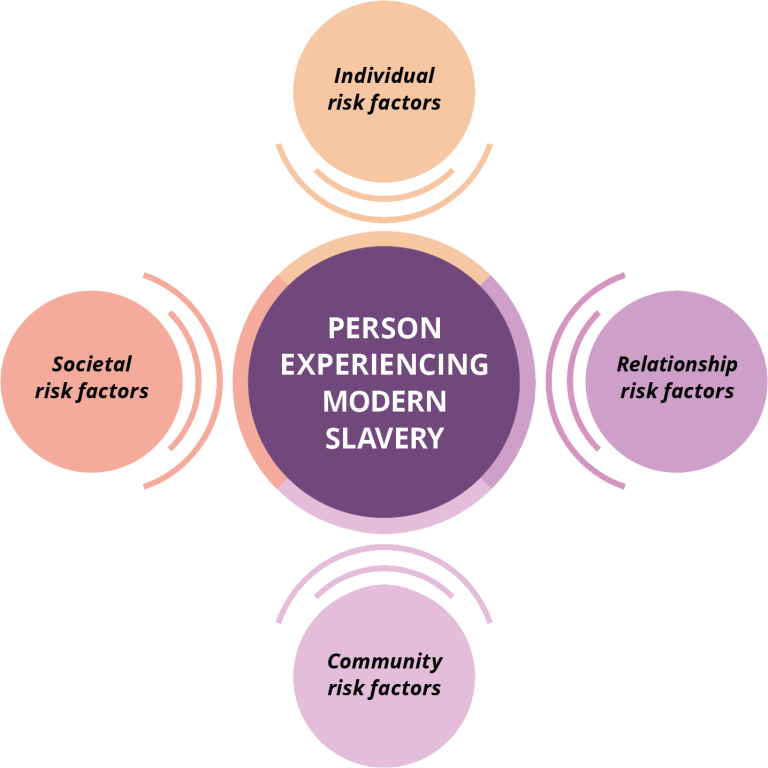
The diagram consists of a circle in the centre titled ‘Person experiencing modern slavery’ that is surrounded by four circles. Each of the four circles has impact lines moving towards the centre circle.
The first circle is titled ‘Individual risk factors’, the second circle is titled ‘Relationship risk factors’, the third circle is titled ‘Community risk factors’ and the fourth circle is titled ‘Societal risk factors’.
- Individual risk factors – such as discriminatory treatment based on immigration status, sexual orientation, race, disability and economic status.
- Relationship risk factors – such as family conflict, social isolation, limited support and peer pressures.
- Community risk factors – such as social norms, community violence, lack of resources and opportunities for education, and natural disasters.
- Societal risk factors – such as lack of knowledge of exploitation and structural inequalities.
Indicators and signs that a person may have experienced modern slavery
Identifying modern slavery is not always a simple process as offenders will go to considerable lengths to hide their activities. Each case is unique, and indicators of modern slavery can vary from person to person.
Several organisations, including, but not limited to, the United Nations Office on Drugs and Crime (UNODC), the International Labour Organization (ILO) and the AFP, have developed specific indicators to help identify someone who is experiencing or may be at risk of modern slavery. Indicators can be used as a way to categorise a particular form of serious exploitation and can be the basis of reports of suspicious activities.

Indicators are most effective when they are tailored to the context of the specific circumstances of a situation. In some circumstances, the presence of one indicator may sufficiently indicate a situation of modern slavery. In other situations, there may be a need to look for several indicators which, taken together, might point to a situation of modern slavery.
In addition to the general indicators below, particular sectors may have established and well-recognised work on how indicators can present in their particular sectors. Individuals and organisations are encouraged to engage with indicators used within their sector groups. Some examples include: Australian Banking Association typologies and indicators of modern slavery, Australian Maritime Safety Authority Table of Risk Indicators, Cleaning Contractors Modern Slavery Guidance. Materials developed should be continually reviewed and refined to ensure adherence to best practice.
Quick reference: Key indicators of modern slavery
For time-constrained or crisis situations, this quick reference provides key indicators to enable rapid identification of potential cases of modern slavery.
For a more detailed guide and context-specific indicators, refer to Section 5 - Useful tools or Appendix A – Examples of modern slavery.
- Work Conditions: Required to work under certain conditions or unable to negotiate their working conditions; excessively long hours; no days off; inadequate breaks.
- Financial Control: No access to or control over earnings; excessive charges for accommodation or living expenses; unexpected financial pressures within the family unit; evidence of economic abuse, dowry abuse or financial gain from the arrangement.
- Movement Control: Show signs of movement being controlled; unable to leave work or accommodation voluntarily; not knowing their home or work addresses; not having a key to their home; transported between accommodation and work by others.
- Living Conditions: Poor or substandard accommodation; controlled in their daily habits (for example, sleeping or eating); subjected to demands for the provision of sex (including to third parties).
- Deceptive Practices: Deceived about the job’s nature, location, employer or their own migration status; have acted on the basis of false promises.
- Violence and Threats: Subjected to violence or threats against self or family; disciplined through punishment.
- Document Control: Not in possession of personal travel or identity documents as they are being held by someone else; in possession of false identity or travel documents.
- Surveillance: Under constant or near-constant surveillance by another person.
- Isolation: Limited or no social interactions; limited or no English; unfamiliar with the local environment; have limited or no contact with their family or with people outside of their immediate environment; unable to communicate freely with others; restricted communications due to limited or no phone access.
- Injuries: Evidence of existing but untreated or unexplained injuries/illnesses; signs of abuse or application of control measures; no or delayed access to medical care.
- Nutrition: Provided with limited or substandard food.
- Appearance: Noticeably low self-esteem and physical appearance; signs of fatigue, poor health or poor hygiene.
- Coached Responses: Respond as though coached by a third party or allows others to speak for them when addressed directly.
- Fear of Authorities: Being threatened with being handed over to the authorities; threatened with deportation; afraid of revealing their immigration status; distrustful of authorities.
- Debt Bondage: Believe they must work against their will; under the perception they are bonded by debt and not free to stop work; have had their travel or visa costs paid for by others, whom they must pay back by working or providing services.
- Dependence: In a situation of dependence on another person.
- Fear and Anxiety: Show signs of fear, anxiety, distress or nervousness.
- Emotional Control: Show signs of psychological control or manipulation.
- Forced Marriage: Family pressures; sudden engagement announcements; controlled finances and communications; upcoming family trip causing anxiety; failing to return from an overseas trip; anxiety or fear about marriage.
- Servitude: No private space; rarely leave home; make excuses for physical injuries incurred at home; few or no personal possessions.
- Forced Labour: Unskilled manual labour for little or no pay; little to no understanding of work rights and entitlements; working in an environment where labour laws are breached; lack training and professional licences.
- Children: No or limited access to education, guardians or accommodation; lives apart from family; engaged in unsuitable work.
While indicators are helpful, they may not always accurately identify someone who has experienced modern slavery. Individuals and organisations using indicators should carefully consider their use to avoid misidentifying individuals and potentially affecting their eligibility for certain types of support.
The trauma-informed practice section in section 4.1 addresses framing indicator tools in a trauma-informed way, as well as how to effectively communicate with someone.
Individuals and organisations should prioritise listening to and believing people who may have experienced modern slavery, even if indicators are not identified or presenting in a typical way (refer to key concepts for identification). It is vital that engagement is free from judgement and people who have experienced modern slavery feel as though they are believed and supported.
"When the inclusion criteria is not fit for purpose, it can preclude people from help. People have been falling through numerous cracks as they get back to some kind of stability."
– Member of the Survivor Advisory Council
Modern slavery and other forms of exploitation
Modern slavery is inextricably linked to other forms of abuse and exploitation, including but not limited to child sexual abuse and family, domestic and sexual violence. It is important to collaborate and align approaches across engagements with people who may be impacted by both modern slavery and other crimes in order to offer multi-dimensional and connected pathways for support.
We recognise that not all individuals and organisations working across these sectors may be trained to recognise certain indicators if they came across a case of modern slavery (refer to incidental identification Section 4.2, Practice Area 1). This demonstrates the importance of providing training to staff and developing clear standard operating procedures for supporting people who have experienced modern slavery so that organisations are able to respond in a trauma-informed way.
Preventing modern slavery
Prevention is a key priority response to modern slavery under Australian and international strategic frameworks. All sectors have an important role in preventing modern slavery by implementing activities that address drivers and root causes of modern slavery, and empowering individuals and groups at risk of modern slavery.
Depending on the sector, prevention activities will take different forms, including:
- building community engagement to reach the people most vulnerable to modern slavery
- working to ensure that there are good practice systems/workplace practices in place to prevent exploitation of one’s own workers
- raising awareness of modern slavery across the Australian community
- advocating for international, regional, and domestic compliance with human rights standards and relevant legislation to address drivers of modern slavery
- partnering with people who have experienced modern slavery and drawing on their experiential insights to inform prevention activities
- identifying actual or potential adverse operational impacts on human rights
- undertaking research to build our understanding of modern slavery, drive evidence‑based responses, and increase confidence in our responses to deliver support, healing and justice to people who have experienced modern slavery.

A key component of addressing and preventing modern slavery is identifying and mitigating risks. IOM have developed resources that can support organisations, especially with regards to ethical recruitment practices.
Migrant Worker Guidelines for Employers provides practical guidance for organisations on how to recruit and employ international migrant workers ethically and responsibly. It outlines steps that employers across various sectors can take in a manner that respects the human and labour rights of migrant workers.
The ILO has also developed videos, guides and training on fair recruitment to support individuals and organisations.